
Generative Adversarial Networks (GANs): The AI Duel That’s Transforming Medicine
Not Rocket Science, Just AI!: Post 025

Imagine this: Two skilled artists in a studio. One artist (let’s call her Gina) tries to paint a photo-realistic human face, and the other artist (Danny) is the art critic tasked with spotting if Gina’s painting is real or fake. With every painting Gina makes, Danny gets sharper at spotting flaws. Meanwhile, Gina learns from Danny’s critiques and improves until Danny’s no longer sure which faces are real or painted. This friendly rivalry is exactly how Generative Adversarial Networks, or GANs, work—except replace artists with AI neural networks, paintings with data, and the studio with a computer.
The Story Behind GANs
GANs skyrocketed into the AI spotlight in 2014 thanks to Ian Goodfellow and his team. Before GANs arrived, generating realistic images or data with AI was kind of like trying to bake a gourmet cake without a recipe—possible but unpredictable and often bland. Goodfellow’s genius idea was to set two neural networks against each other:
A Generator creating fake data and a Discriminator judging whether the data is real or not

This adversarial setup meant both got better with practice, leading to impressively realistic outputs.
The Genius Idea of Strange Bedfellows
How do GANs do it? The two networks are in a constant game of one-upmanship—think of it like a secret agent film where each tries to outsmart the other.
The Generator takes random noise (imagine a digital blob) and transforms it into data that looks real. The Discriminator looks at both genuine data and fake data, trying to distinguish between the two.
Why?
Because the Generator’s goal is to fool the Discriminator into thinking its crafted data is authentic, while the Discriminator tries to get better at catching the fakes. Over time, if both are trained well, the Generator becomes so good that even experts (or the Discriminator) struggle to tell what’s real.
GANs’ Anatomy: Breaking Down the Components
Generator (G):
Think of this as the “forger” in the art analogy. It creates new synthetic data by transforming random noise into data samples. For example, generating synthetic medical images.
Discriminator (D):
The “art critic” who evaluates data samples, labeling them real (from the actual dataset) or fake (from the Generator).
Noise Vector:
The random input to the Generator, like a block of marble the artist starts sculpting.
Training Data:
Real data used to train the Discriminator and train the Generator indirectly.
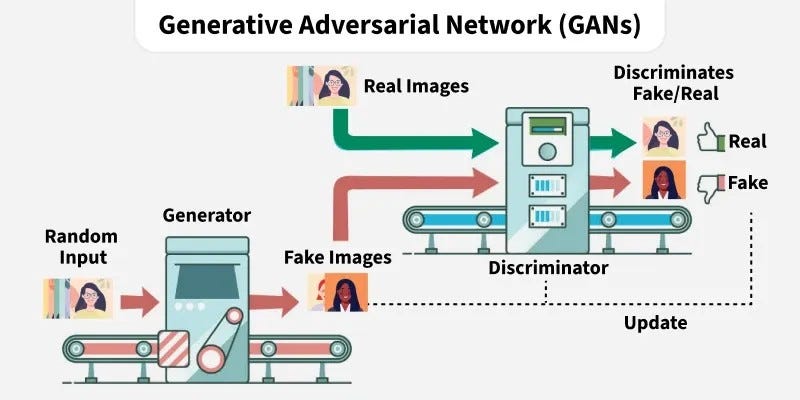
The magic lies in their simultaneous training. With every round, the Generator improves to produce more realistic samples, and the Discriminator sharpens its detection powers. This tug-of-war continues until the Discriminator can no longer reliably distinguish real from fake, which means the Generator is producing eerily realistic data.
Real-Life Wins: From Sci-Fi to Medical Marvels
GANs might sound like a tech novelty but in medicine, they’re becoming superheroes:
Medical Image Synthesis:
GANs generate realistic MRI, CT, and retina images for training medical AI without the risk of patient privacy breaches. For example, GAN-generated brain MRIs and skin lesions have been deemed indistinguishable from real ones by experts, helping boost training datasets where real data are scarce or sensitive.
Enhancing Image Quality:
DeepMind uses GANs to turn low-quality MRI scans into high-res images, making diagnosis clearer without expensive machinery.
Synthetic Data for Training:
GANs augment datasets, improving the performance of models in tasks like disease prediction and detection, thus addressing the "data hunger" problem in AI medical research.
Disease Progression Prediction:
AI models powered by GANs predict how conditions like diabetic retinopathy evolve, aiding early intervention.
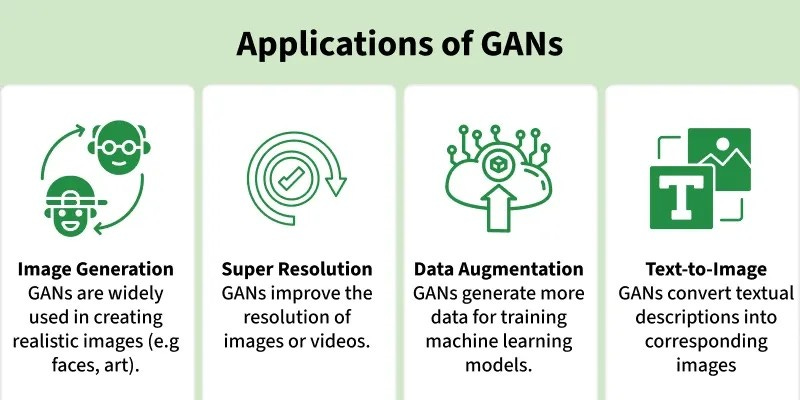
Beyond medicine, GANs create stunning digital art, fake-but-real human faces (NVIDIA’s StyleGAN), and even synthetic data for self-driving cars.
Why Should Medical Folks Care?
Data scarcity and privacy are massive hurdles in medical AI. GANs offer a way to generate synthetic yet realistic data for training without risking patient confidentiality. Plus, they can enhance imaging quality and provide novel predictive models that push healthcare forward.
GANs: Still a Work in Progress
Though phenomenal, GANs aren’t magic bullets. Some GAN-generated medical images don’t yet capture every nuance of real patient data, and training them is tricky, often requiring significant computational power and expertise. But the pace of innovation is staggering, with new architectures growing more stable and realistic every year.
In summary:
Generative Adversarial Networks are like the AI version of a creative rivalry that pushes boundaries and creates astonishingly realistic synthetic data.
For medical professionals, this means cutting-edge tools for better training data, enhanced imaging, and smarter diagnostics, all while maintaining patient privacy.
So next time the Generator and Discriminator go head-to-head, remember: it’s not just AI battling itself, it’s a breakthrough for healthcare innovation!
Interesting reads:
Ian Goodfellow et al., "Generative Adversarial Nets," 2014 — foundational paper introducing GANs